SaaS Demo Video ROI: $3,500 Agency vs $7 With AI in 2026

A 60-second B2B SaaS demo video quotes at $3,500 and takes five weeks. Here's the full generation arithmetic that gets the same cut for under $8 — plus the three cases where you should still pay the agency.
The $3,500 line item nobody wants to defend
You need a 60-second demo video for the new pricing page. You get three quotes back: $2,800, $3,500, and $6,200. The mid quote comes with a five-week timeline, two rounds of revisions, and a script call on Thursday. Meanwhile, your product is shipping a new onboarding flow in nine days, which will make half the footage stale before it renders.
Every B2B SaaS founder has lived this. The video isn't optional — landing pages with a product video convert meaningfully better than ones without, and paid social simply doesn't run on screenshots. But the cost structure of traditional production is built for a world where you shoot once a year, not one where you ship weekly.
The realistic alternative in August 2026 is generating the human-facing parts of your demo — the founder intro, the persona scenes, the "before you had our product, your Tuesday looked like this" cold open — with AI, and keeping only the actual screen capture as real footage. That's what our SaaS / app demo videos workflow is built for.
▶ Try in VO3 AI
Build your SaaS demo video → — start from a prompt, not a production calendar.
Why the economics moved this week specifically
Two model releases changed the per-second math, both within the last several days.
ByteDance's Seedance 2.5 went live on Jimeng and Doubao on July 31 and hits the full experience center and API tomorrow, August 7 — native 30-second 4K output with audio, up to 50 multimodal reference inputs, and extension to 180 seconds. (Vendor announcement: seed.bytedance.com — check the changelog date yourself before you quote it in a deck.) Thirty native seconds with synced audio is the number that matters here: a demo video's whole job is a continuous narrated take, and until this year you were stitching 5-8 second fragments and praying the voice matched.
Earlier this week, Black Forest Labs pushed FLUX 3 Video to general availability and publicly benchmarked it against Seedance 2.0 (blackforestlabs.ai). And TikTok rolled out longer-form AI video ad placements, which is the demand-side half of the same story — the platforms are actively making room for generated inventory (ads.tiktok.com).
Two competing frontier video models plus a platform expanding generated-ad slots in the same week is what a price floor collapsing looks like.
Mike Futia's build is the clearest signal of where this is going for agencies: a single skill that takes a product plus one prompt and returns an on-camera AI presenter, a script, a shot-by-shot storyboard, and a finished cut. That's the entire deliverable an agency bills a retainer for.
The workflow block
🎬 SaaS Demo Video — Founder Intro Cut
Recommended model: Seedance 2.5 AI video generator — native 30s, 4K, synced audio, strong multi-reference character consistency. (Veo 3.1 is the alternative if you need tighter camera-language control; Seedance wins on unbroken length.)
Prompt (verbatim):
Medium close-up, 50mm lens, shallow depth of field, natural window light
from camera-left. CHARACTER: Maya Okonkwo, 34, Black woman, short natural
coils, thin gold hoop earrings, charcoal crewneck sweater, seated at a
light oak desk in a bright modern startup office, blurred glass meeting
room and a whiteboard behind her.
ACTION: She looks directly into the lens, relaxed and conversational, and
says: "We built this because our own ops team was spending eleven hours a
week reconciling invoices by hand. Let me show you what that looks like
now." On "let me show you" she gestures open-palmed toward camera-right,
leaving clean negative space on the right third of the frame.
AUDIO: Clear direct-address dialogue, no music bed, quiet room tone with
faint keyboard ambience.
STYLE: Documentary-realistic, neutral color grade, no lens flare.
The negative space on the right third is deliberate — that's where your screen capture wipes in.
Credits: VO3 AI's $2.99 starter pack ≈ 10 generations at 10s/1080p — roughly 4 finished cuts after rerolls. Full per-model rates on the AI video model pricing page.
Output: 10-30s per generation, typically 90-180 seconds of wall-clock generation time per clip.
▶ Try in VO3 AI
Generate this scene now → — paste the prompt above, swap in your own founder.
Show me the arithmetic
Fair criticism of every ROI post like this one: the AI-side numbers get asserted while you're told to verify the agency quotes yourself. So here is the full derivation, and you should check each input against the pricing page rather than taking it from the vendor selling the credits.
- $2.99 starter pack ÷ ~10 generations = ~$0.30 per generation (10s, 1080p, Seedance 2.5 tier)
- Reroll rate: ~2.5 generations per usable cut. This is the honest number from internal showcase production, not a marketing figure — dialogue-heavy shots with a named character fail on lip timing or hand artifacts roughly 60% of the time on the first pass. Pure b-roll reruns closer to 1.4×.
- $0.30 × 2.5 = ~$0.75 per finished 10-second cut
- A 60-second demo = 6 cuts × $0.75 = ~$4.50 in raw generation
- Plus one voiceover pass and a music bed: ~$2-3
- All-in: $7-8 per finished 60-second demo video
If your reroll rate is 4× instead of 2.5× — likely on your first week — you're at $12. Still two orders of magnitude off the quote.
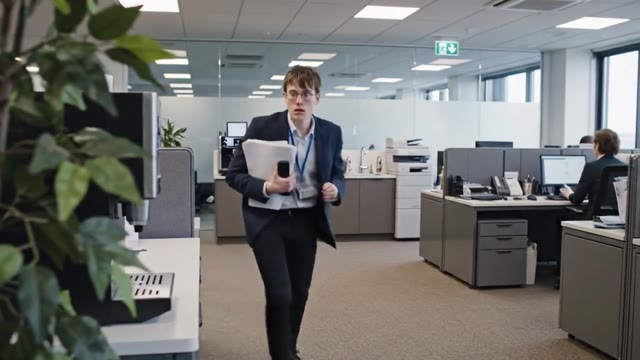
Here's a generated office-persona scene using the same character-consistency and synced-dialogue stack the founder prompt above relies on. It's a comedy piece rather than a SaaS demo, but the load-bearing capabilities are identical: one named character, consistent wardrobe and face across shots, direct narration locked to picture.
Generated with VO3 AI — a wildlife-documentary parody following an anxious office intern's quest for free coffee. Judge the character consistency and the audio sync, not the joke.
Head-to-head: traditional vs generated
| Agency / freelance | VO3 AI | |
|---|---|---|
| Cost per 60s demo | $2,800-$6,200 | $7-8 |
| First usable cut | 3-5 weeks | ~15 minutes |
| Revision round | 4-7 days, often billed | Reroll: ~3 min, ~$0.75 |
| Demos per quarter at $3,500 budget | 1 | ~440 |
| Localized variants (5 languages) | +$1,200-2,000 | Re-prompt: ~$35 |
| Cost of a stale cut after a UI change | Reshoot | Regenerate the affected cut |
The volume row is the one that actually changes behavior. At one video per quarter you make a brand video. At forty you make a video per feature, per ICP, per objection — which is what AI video for marketing is really for.
WaveSpeedAI's three-step chain — generate consistent character frames, lay them into a storyboard for narrative pacing, then run them through Seedance — is the correct production order. Generate your keyframes first, lock the look, then run image-to-video so you're not gambling the composition on every reroll.
Two scenarios with real numbers
Seed-stage B2B SaaS, pre-launch. You have $40k of runway per month and no video budget. Old plan: skip video, ship a screenshot-only landing page, revisit in Q4. New plan: $30 of credits buys a 60-second hero demo, three 15-second feature cuts for the pricing page, and six 8-second paid-social variants for LinkedIn testing. Total spend under $40 and two afternoons. If the hero demo lifts trial signup conversion from 3.1% to 3.8% on 8,000 monthly visitors at a $400 LTV, that's roughly $22k in annualized new pipeline against $40 of credits.
Agency running six SaaS clients. Currently subcontracting video at $1,800 per deliverable and reselling at $3,500 — $1,700 margin, five-week turnaround, one deliverable per client per quarter. Moving generation in-house: cost per deliverable drops to under $10, so the same $3,500 price becomes a ~$3,400 gross-margin line before your editor's time. More importantly, you can now say yes to "can we also get a Spanish version and three ad cuts" without repricing. Six clients × two extra deliverables per quarter is $42k of incremental annual revenue you were previously declining on capacity grounds.
Three cases where you should still pay the agency
This post is worthless if it can't name where it's wrong. Three real ones:
1. Regulated and enterprise-committee buyers. If your demo goes in front of a procurement committee at a bank, a hospital system, or a defense contractor, generated humans are a liability. Some enterprise buyers now require disclosure of synthetic media in vendor materials, and "is that a real employee?" is a question you do not want interrupting a security review. Shoot real people.
2. Actual UI, always. Nothing generative replaces a screen recording of your product. If a viewer can't tell what your software looks like after watching, the video failed regardless of production value. Generation handles the human framing — the founder, the persona, the problem scene, the b-roll. The middle 40 seconds should be OBS or Screen Studio at 60fps, with a real cursor, on real data. Any workflow that tells you otherwise is selling you credits.
3. Brand-system-locked campaigns. If you have a locked type system, a licensed spokesperson, motion-design rules, and a competitor-comparison spot going on connected TV, an agency delivers pixel-exact adherence and indemnity. Generation delivers 90% adherence and no indemnity. For a $200k media buy, that 10% is the whole risk.
The honest framing is not "fire the agency." It's that the 40 videos per year you were never going to commission at $3,500 each are now viable, and the two you were going to commission may still be worth commissioning.
If you want frame-level control beyond what a prompt gives you, Mickmumpitz's free local ComfyUI workflow is the deep end — worth knowing exists, not worth your Tuesday.
Try it yourself
Start with the single highest-leverage cut: the 10-second founder intro at the top of your pricing page. Use the prompt in the workflow block, swap the character description for your actual founder's description, and keep the negative space on the right third so your screen capture has somewhere to land.
Budget one starter pack — $2.99, about ten generations, four usable cuts. If cut three doesn't beat your current static hero image in a two-week A/B test, you've lost three dollars and an afternoon, which is the entire point.
VO3 AI runs Seedance 2.5, Veo 3.1, Kling, Hailuo and the rest behind one credit pool, so you can A/B the model as cheaply as you A/B the script. Everything above runs through the same AI video tool — no local install, no ComfyUI graph. Full site: https://vo3ai.com
▶ Try in VO3 AI
Generate your first SaaS demo cut → — $2.99 starter pack, roughly four finished cuts, live in fifteen minutes.
Ready to Create Your First AI Video?
Join thousands of creators worldwide using VO3 AI Video Generator to transform their ideas into stunning videos.
📚 Related Posts:
What is VO3 AI Video Generator: The Ultimate AI-Powered Video Creation Platform
Discover VO3 AI Video Generator - the revolutionary AI video creation platform
Read More →VO3 AI vs. Veo3 — What's the Difference?
Understand the key differences between VO3 AI and Google's Veo3
Read More →How to Use VO3 AI Video Generator: Complete Guide
Master VO3 AI Video Generator with our comprehensive tutorial
Read More →VO3 AI Video Generator - Where imagination meets innovation
Built on top of multiple AI video models including Veo3. Start your creative journey today and join the future of video creation.